I started this blog to dive into things I observed in nature, but have weaved and swerved through various themes and topics over the years. Today, however, we’re going old school, bebe, and diving into a plant that I had no idea what it looked like during the long journey to get there, and upon seeing it, I was well… not exactly blown away. Through the process of writing the blog, I go from sorta unimpressed to blessed in having seen a flowering Howell’s Tauschia (or Howell’s umbrellawort), aka Tauschia howellii.
From our rental in Susanville (very North East California), we set out early towards Reno on June 6th, 2025. The first day of the weekend adventure involved hip hopping all over the place between Reno, Sierra Valley, and the PCT trailhead at Love Falls along the Yuba River. Highway 49 snakes alongside the Yuba River, which we had not yet traversed… ever! Through our five years as nomads in California, we’ve traveled on many highways, and it was refreshing and exhilarating driving on this new-to-us highway. Gosh, it was gorgeous! All the little towns like Sierra City, Downieville, and Goodyears Bar, where we left 49 and went up, up and up, were classic historical gold rush California vibes.
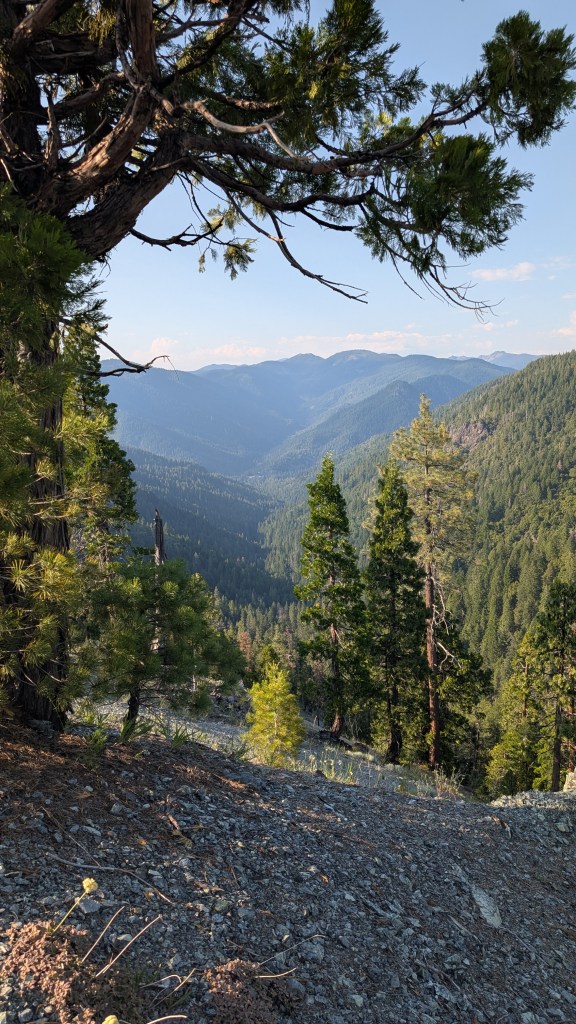
The journey to Keystone Gap, the final destination, first included Mountain House Road, then a quick oopsie turn around through the town of Forest / Forest City, to Pilocene Ridge Road, and then various numbered National Forest Roads of diverse quality.
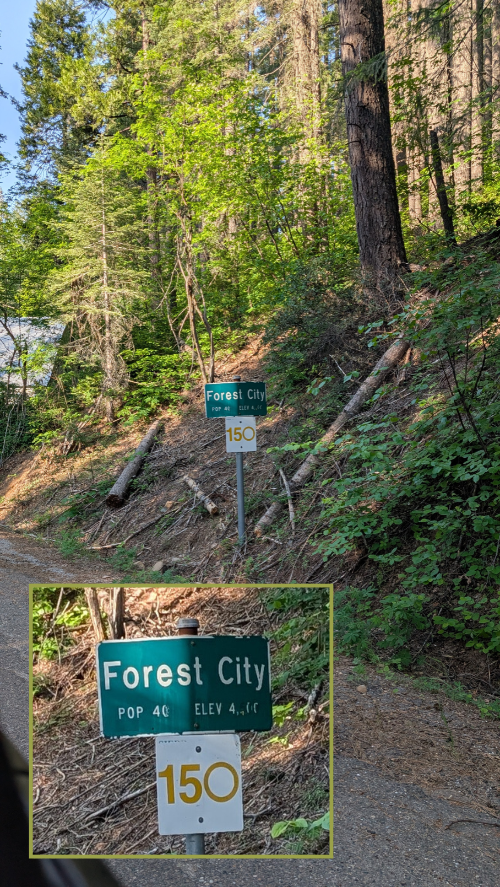
Our navigational oopsie led us briefly into Forest, a town Trevor thought had a population of 4 due to an old sign, which was really 40, a big difference bah! Forest consisted of less than a dozen buildings on the main block, a relic of more populous times from mining or logging. Two men were chumming it up in the old dance hall or old saloon, which was so precious, characters for sure.
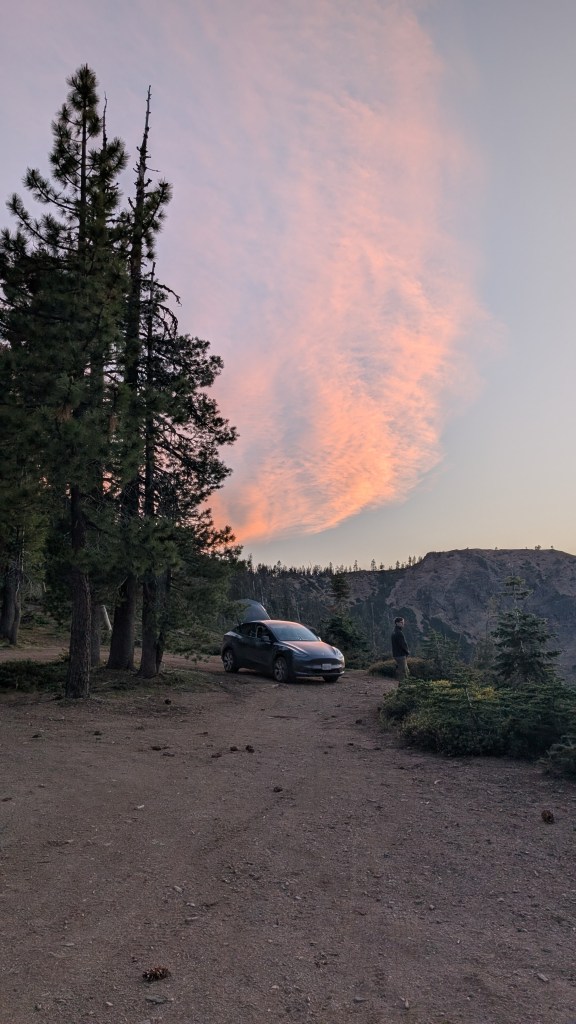
Once we left the pavement of Pliocene Ridge Road, navigating in our vehicle, which we consistently push to the limit became interesting. A failed attempt, continually eyeing the roads to guess their quality later on, and slowly inching around fallen trees and through bumpy rocky sections, all were a part of the journey to get to Keystone Gap. This is the spot where the desired plant habitat and our campsite would be one in the same.
I breathed a sigh of relief when we made it to the Gap after 2.5 to 3 hours since turning off Highway 49. I then began puttering around with dinner prep, while Trevor went to find the plant before the sun went down, and of course *clap clap clap* he was successful. Some hand waving and distant mumbling of “I found it” caused another sign of relief to expel out of my body. Phewf.


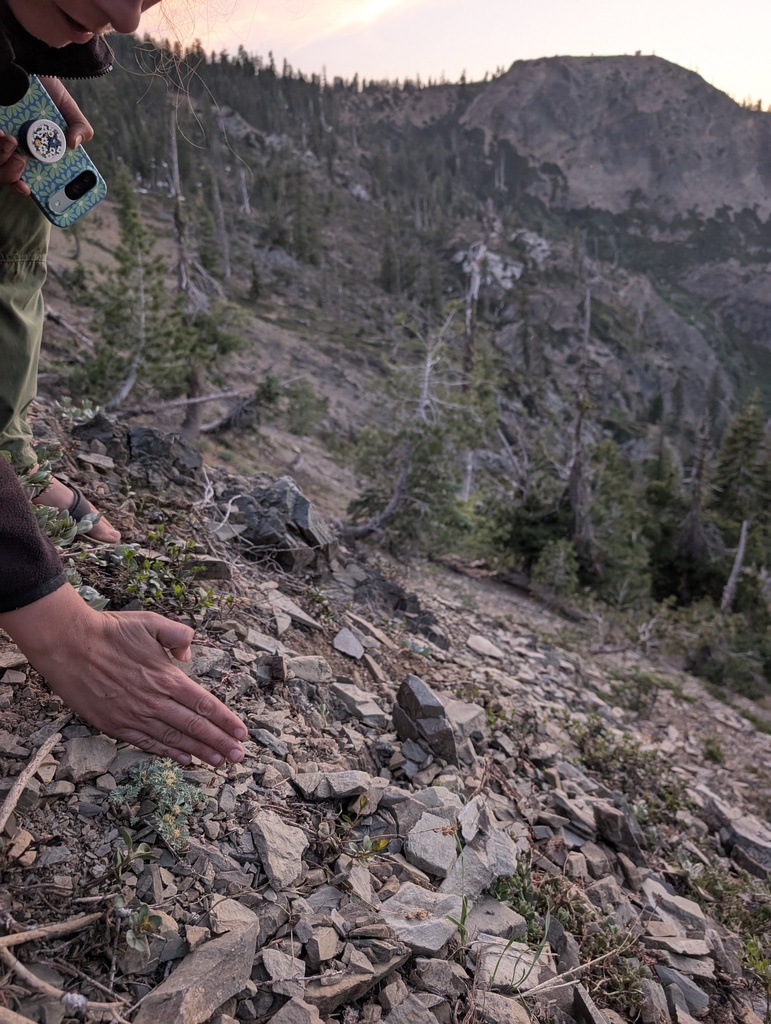
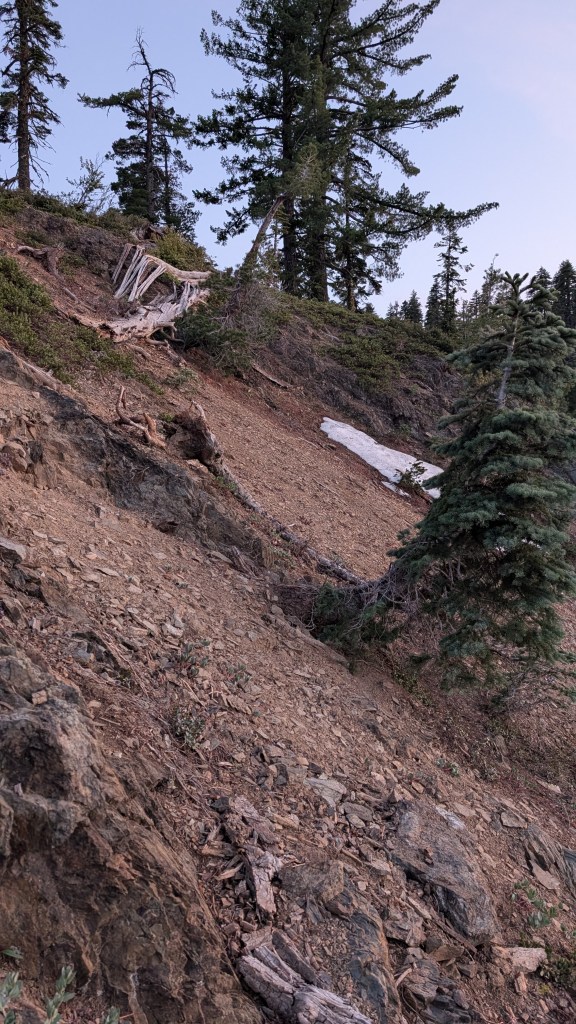
Before the sun really set, and dinner got going in full swing without bothering to put proper shoes on I followed Trevor across a steep and compact hillside directly in site from where the car was parked. My squishy Tevas, meant for camp and creek crossings, had me feeling uneasy about descending out of the safety of larger scrub bushes, aka hand holds.
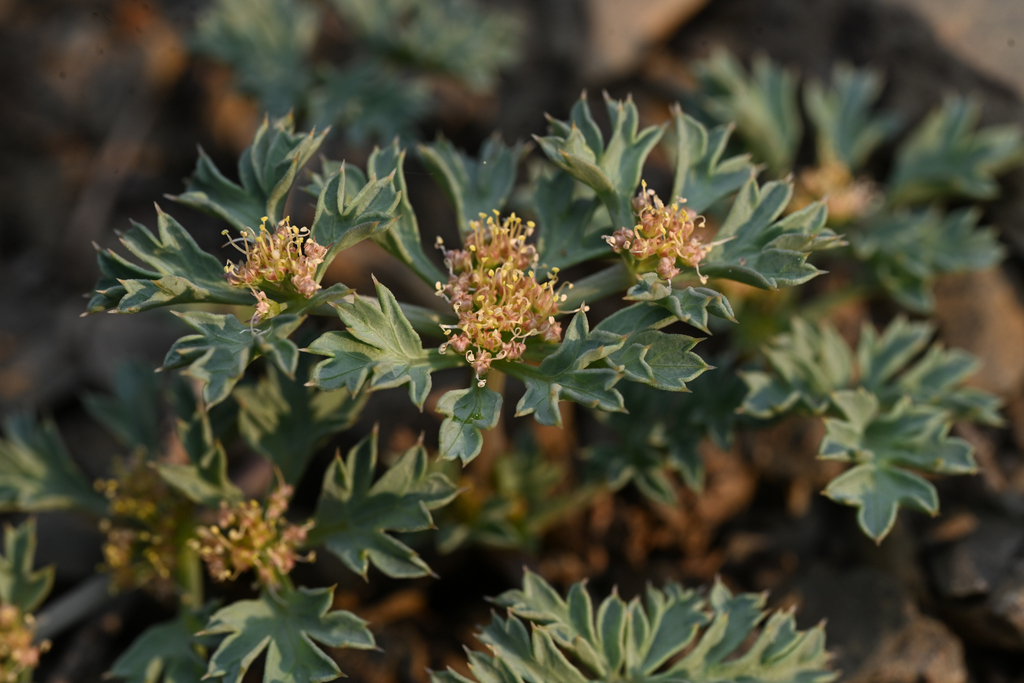
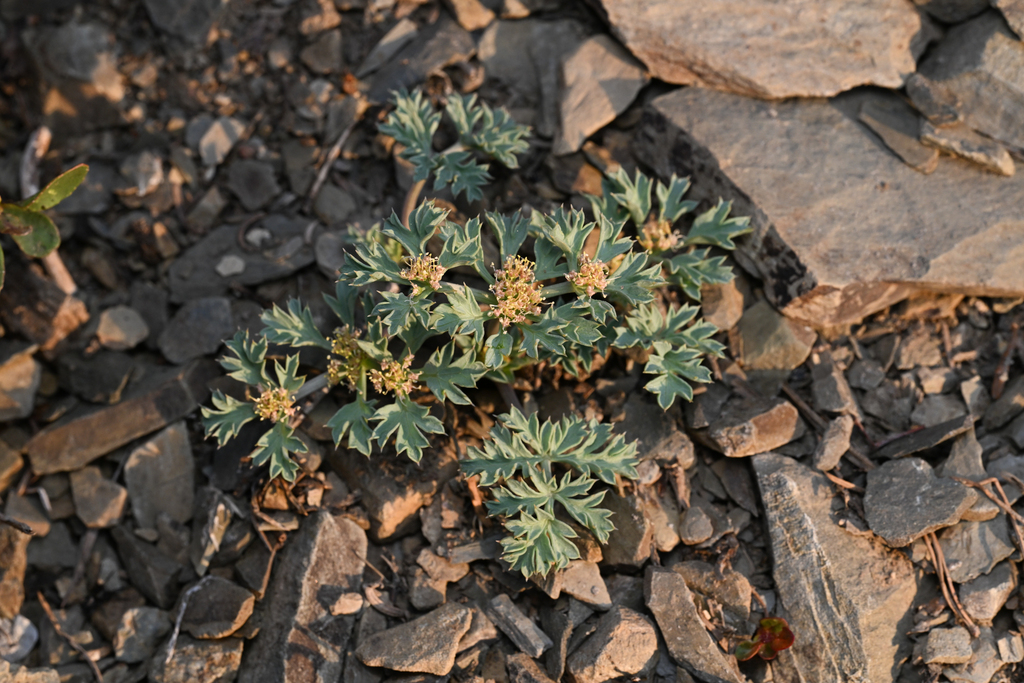
When I got sight of this little spikey beast, I was mildly impressed by its small but mighty mounded structure, its sagey-green spikey-edged leaves and tiny yellowy-pink inflorescence, which are much more impressive through a magnified camera lens. The precarious slope didn’t welcome any belly-botanizing. The setting sun drew out a calm but subtle mighty vibe from this exposed rarity.
When my ankles and calves had had enough, and my photography desires met, we scampered off the hillside and back to the safety of the campsite. I was delighted to add a new plant species to my memory bank. Check.
FORMALLY Meet Howell’s Tauschia!
Family & Form: A perennial herb in the carrot/parsley family (Apiaceae), T. howellii is hairless, with a short stem (5–80 cm tall) and compound umbels of yellow or white flowers.
Leaves & Fruit: The plant features thick, pinnate leaves with sharply serrated leaflets and upturned margins, all on long petioles. Its fruits are small, oblong, and ribbed (2-4 mm).
Soil and Surroundings: Prefers dry, soil and/or bare rock (think talus/scree) on granitic gravel on ridgelines in high-elevation conifer forests (e.g., Shasta red fir). Found between approximately 2000–2500 m elevation.
Conservation Status: California designates it as Rare Plant Rank 1B.3. Despite its rarity, populations appear stable with no major threats identified beyond its small range.
What makes this guy unique?
Geographic Range
- Known from only about nine known occurrences from granitic gravel ridges, in Abies magnifica var. shastensis (Shasta red fir) forests in Northern CA and Southern OR, in high-elevation conifer forests (2,000-2,500m / 6,560-8200 ft). CalFlora Distribution Map
- Northern California: 4 populations in Siskiyou, Shasta, Trinity, & Southern Sierra Nevada, which is a disjunct population
- Southern Oregon: 5 populations in Jackson & Josephine Counties within Rogue River-Siskiyou and Klamath National Forests
Appearance
- Nearly stemless, with leaves and flowers arising directly from the base, which helps with survival on exposed ridgelines
- The leaflets’ sharply toothed blue-green/sage edges curve upward, giving the foliage a sculpted and “tough” appearance, which minimizes water loss
- Flower clusters are compact and sit close to foliage on short rays
- Adapted to granitic, high-elevation ridges — a habitat less favored by other genus members
History
The species was first described by John Merle Coulter and Joseph Nelson Rose. Originally, it was classified under a different genus. In 1918, botanist James Francis Macbride revised the classification, transferring the plant into the genus Tauschia, and establishing the current combination Tauschia howellii. The species epithet “howellii” honors John Thomas Howell (1903–1994), a distinguished American botanist affiliated with the California Academy of Sciences.

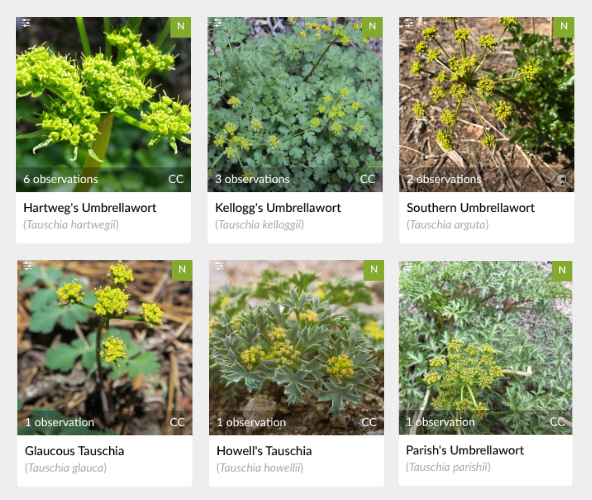
Below are all the Tauschia species Trevor and I have documented via iNaturalist. This hopefully helps you picture the genus better as a whole and how clearly it belongs to the carrot/parsley family, Apiaceae.
In Conclusion. . .
So am I blessed to have met this new plant, yes indeed. How about obsessed? Hmmm, nope, but I have a great appreciation and understanding of this species, and I look back fondly on the adventure required to find it. It really is all about the journey sometimes… more like most of the time.
Links
- Oregon Flora has good close-up photos of live and herbarium specimens
- CalFlora page
- Our Howell’s Taushia iNaturalist observation
 Chloe Van Loon's Nature Blog